How Advanced & Bio-Based Materials Are Powering the Next Era of Automotive Innovation
The automotive industry is reinventing itself at an unprecedented pace.
Electrification, tightening CO₂ regulations, cost pressure, and platform consolidation are colliding – all while OEMs are expected to deliver better performance, better design, and better sustainability. At the center of this transformation is a single enabler: materials.
At Mitsubishi Chemical Group, our mission is to partner with OEMs and Tier suppliers across the mobility value chain, from early R&D through full-scale production, delivering advanced, high-performance material solutions that enable innovation, quality, and sustainability at scale.
Driving the Future Together
The mobility sector is under pressure on multiple fronts: tightening regulatory standards for emissions and recyclability, growing consumer demand for eco-friendly mobility, and fierce competition for performance and cost-efficiency. In this environment, materials are no longer supporting players, they are strategic differentiators that shape vehicle architecture, manufacturing efficiency, and long-term performance.
For MCG, material innovation means delivering solutions that:
Reduce weight while improving strength
Support sustainability goals without performance trade-offs
Enhance manufacturability and speed to market
Enable design freedom for next-generation platforms
Our bio-based and engineering polymers are designed to help OEMs meet these demands today and prepare for tomorrow’s challenges.
Bio-Based Engineering Plastics
One of the most compelling developments in automotive materials is the rise of bio-based engineering plastics – materials that reduce reliance on fossil fuel feedstocks while delivering high-end performance.
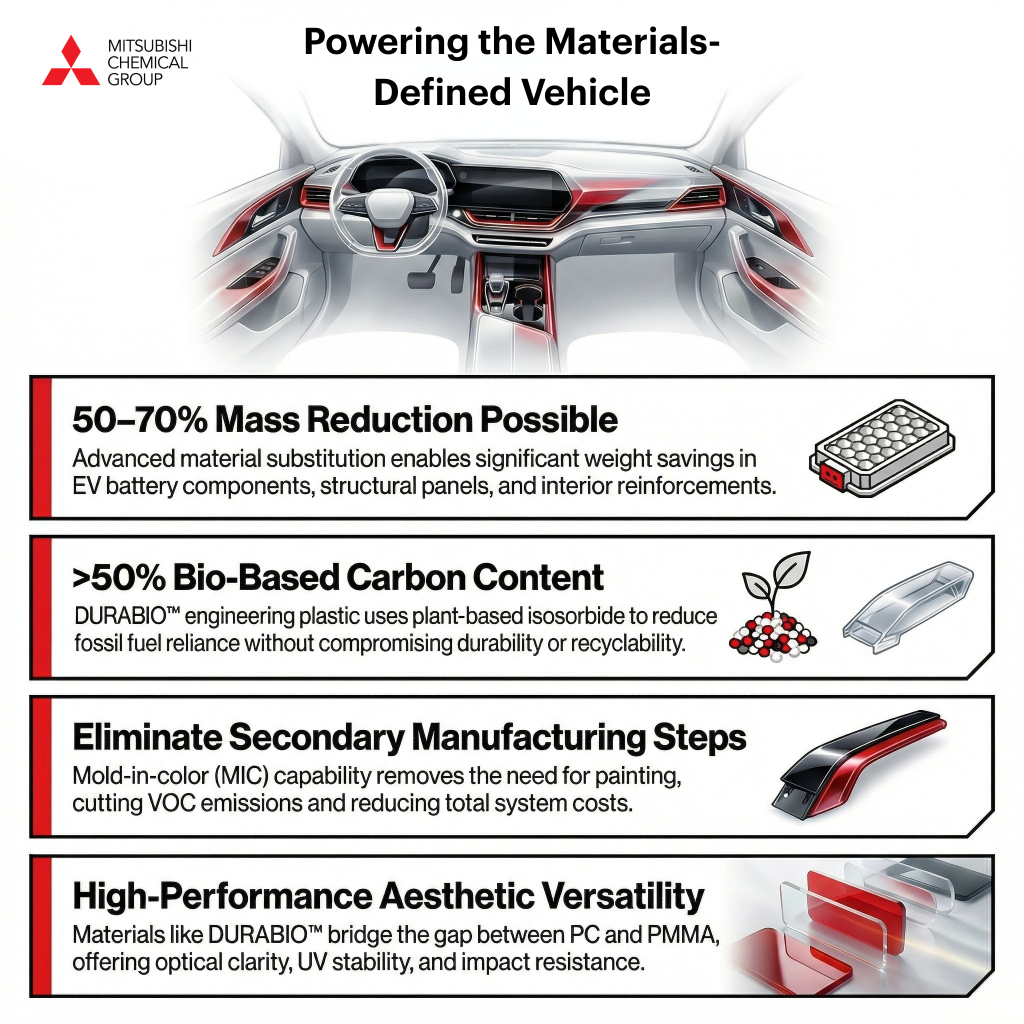
DURABIO™, developed by Mitsubishi Chemical Group, exemplifies this new class of material. Made primarily from plant-based isosorbide, DURABIO™ achieves a certified bio-based carbon content of over 50% while offering performance that rivals – and in some cases exceeds – conventional engineering plastics.
Unlike many bio-based materials, DURABIO™ is designed for durability and recyclability -not biodegradation – ensuring long-term reliability in demanding automotive environments.
Materials That Deliver Sustainability and Performance
DURABIO™ occupies a unique place between traditional polycarbonate (PC) and polymethyl methacrylate (PMMA), offering a blend of optical clarity, impact resistance, UV stability, and surface hardness that meets the aesthetic and durability requirements of modern mobility design.
What makes it especially attractive for automotive manufacturers:
Compatibility with standard equipment – OEMs don’t need new tooling to adopt the material, lowering barriers to implementation.
Application versatility – from exterior trims and grilles to interior components where clarity, strength, and finish quality matter.
High-profile brands are already adopting DURABIO™ in production vehicles, a testament to its performance and industrial readiness.
How Thermoplastics & Bio-Based Polymers Are Transforming Design
The move from traditional materials like rubber and petroleum-derived plastics to thermoplastics and bio-based polymers isn’t just about sustainability, it’s about enabling design creativity, weight reduction, and production efficiency.
“The future of mobility will be shaped by the materials we choose today,” says Fallyn Flaherty-Earp, the Automotive Market Director at Mitsubishi Chemical Group. “At MCG, our focus is on developing advanced and bio-based material solutions that help automotive manufacturers meet performance, sustainability, and manufacturing demands simultaneously – without compromise.”
Materials such as thermoplastic elastomers and engineered polymers support:
Lighter vehicles, which improve fuel efficiency and EV range In real-world development programs, this impact can be significant. Across select applications – including EV battery components, structural panels, and interior reinforcements – advanced material substitution can enable mass reductions of up to 50–70%, depending on design requirements and performance target.
Greater design flexibility for parts consolidation and complex geometries
Improved process efficiency with faster cycle times and reduced waste
Bio-based plastics like DURABIO™ elevate this further by aligning material performance with environmental goals – helping OEMs meet strict regulations and consumer expectations without compromise.
Manufacturing Without Compromise
In today’s automotive world, manufacturing efficiency is as critical as end-use performance. MCG materials are engineered to support high-volume, high-quality production. They help:
Reduce secondary processes like painting
Improve dimensional stability and surface finish
Lower emissions and simplify supply chains
OEMs and Tier suppliers are increasingly prioritizing materials that reduce total cost of ownership, not only through part cost, but by eliminating secondary operations, shortening cycle times, reducing scrap, and lowering energy consumption during processing.
By approaching material design through the lens of real-world production challenges, we help customers accelerate time-to-market while maintaining competitive differentiation.
Driving Sustainability Forward, Without Trade-Offs
Sustainability doesn’t have to be a compromise. At MCG, our strategy integrates bio-based inputs, recyclable compounds, and lightweight solutions that reduce environmental impact while enhancing performance.
As vehicle ownership cycles extend from an average of seven years toward ten, durability and long-term material performance are becoming increasingly important, particularly for components expected to withstand repeated thermal, mechanical, and environmental stress over time.
Our material portfolio, including bio-based plastics like DURABIO™ and engineered thermoplastics, supports customers in meeting sustainability targets, regulatory demands, and consumer preferences simultaneously.
A Partner Across the Mobility Value Chain
From concept validation to launch, MCG works as an extension of our customers’ teams. We bring deep expertise, global manufacturing scale, and collaborative problem-solving to every engagement – helping OEMs and Tier suppliers innovate faster, operate smarter, and grow stronger.
Supply chain resilience has become a critical factor in material selection. OEMs are increasingly focused on qualifying solutions that can be produced locally while maintaining consistent quality, specifications, and batch-to-batch repeatability across global regions.
We don’t build cars. We build what builds cars – and we’re proud to help shape the future of mobility, together.
What Comes Next: The Materials-Defined Vehicle
As vehicles become more connected, electrified, and software-driven, the role of materials is shifting, from supporting design decisions to defining what design makes possible. The next generation of mobility will not be shaped by hardware alone, but by material choices that enable flexibility, speed, and system integration.
Across the automotive industry, several material-driven challenges consistently shape development conversations with OEMs and Tier suppliers. At MCG, we consistently see:
Lightweighting without compromising durability or performance
Simplifying manufacturing to reduce total system cost
Ensuring global supply consistency while enabling localized production
Fewer Parts Through Smarter Materials
The push for simplified architecture is accelerating. OEMs and Tier suppliers are looking to reduce complexity, cost, and weight by consolidating components and eliminating unnecessary assemblies.
Advanced thermoplastics and engineered polymers make this possible by enabling:
Parts consolidation through complex geometries and multifunctional designs
Integrated sealing, damping, and structural performance within a single component
Reduced reliance on secondary materials, fasteners, and adhesives
By doing more with fewer components, materials help streamline manufacturing while improving system-level performance and reliability.
Enabling Software-Defined Hardware
As vehicles evolve into software-defined platforms, physical components must adapt. Sensors, electronics, and digital systems demand materials that offer precision, consistency, and long-term durability – all while supporting rapid design iteration.
Material science plays a critical role in enabling:
Dimensional stability for sensor alignment and ADAS systems
Thermal management and electrical insulation for electrified architectures
Surface quality and optical performance for human–machine interfaces
In this environment, materials are no longer passive. They actively support the integration of software, electronics, and mechanical systems into cohesive vehicle platforms.
Faster Platform Refresh Cycles
Shorter development timelines and more frequent platform updates are becoming the norm. Materials must keep pace, not just in performance, but in their ability to move quickly from concept to production.
MCG materials are designed with:
Production-ready processing using existing equipment
Consistent quality and global availability to support rapid scaling
Engineering support that accelerates validation and launch
This approach enables OEMs and Tier suppliers to respond faster to market demands, regulatory changes, and evolving consumer expectations without compromising quality or manufacturability.
Materials as a Strategic Advantage
The materials-defined vehicle represents a fundamental shift in how mobility systems are designed and built. In the future, success will depend on partners who understand both the science behind the material and the realities of automotive production.
At MCG, we are focused on helping customers navigate this transition, delivering material solutions that reduce complexity, enable innovation, and support the speed of modern automotive development.
Because the future of mobility won’t just be engineered. It will be material-defined.
To provide the best experiences, we use technologies like cookies to store and/or access device information. Consenting to these technologies will allow us to process data such as browsing behaviour or unique IDs on this site. Not consenting or withdrawing consent, may adversely affect certain features and functions.
Functional
Always active
The technical storage or access is strictly necessary for the legitimate purpose of enabling the use of a specific service explicitly requested by the subscriber or user, or for the sole purpose of carrying out the transmission of a communication over an electronic communications network.
Preferences
The technical storage or access is necessary for the legitimate purpose of storing preferences that are not requested by the subscriber or user.
Statistics
The technical storage or access that is used exclusively for statistical purposes.The technical storage or access that is used exclusively for anonymous statistical purposes. Without a subpoena, voluntary compliance on the part of your Internet Service Provider, or additional records from a third party, information stored or retrieved for this purpose alone cannot usually be used to identify you.
Marketing
The technical storage or access is required to create user profiles to send advertising, or to track the user on a website or across several websites for similar marketing purposes.
To provide the best experiences, we use technologies like cookies to store and/or access device information. Consenting to these technologies will allow us to process data such as browsing behaviour or unique IDs on this site. Not consenting or withdrawing consent, may adversely affect certain features and functions.
Functional
Always active
The technical storage or access is strictly necessary for the legitimate purpose of enabling the use of a specific service explicitly requested by the subscriber or user, or for the sole purpose of carrying out the transmission of a communication over an electronic communications network.
Preferences
The technical storage or access is necessary for the legitimate purpose of storing preferences that are not requested by the subscriber or user.
Statistics
The technical storage or access that is used exclusively for statistical purposes.The technical storage or access that is used exclusively for anonymous statistical purposes. Without a subpoena, voluntary compliance on the part of your Internet Service Provider, or additional records from a third party, information stored or retrieved for this purpose alone cannot usually be used to identify you.
Marketing
The technical storage or access is required to create user profiles to send advertising, or to track the user on a website or across several websites for similar marketing purposes.