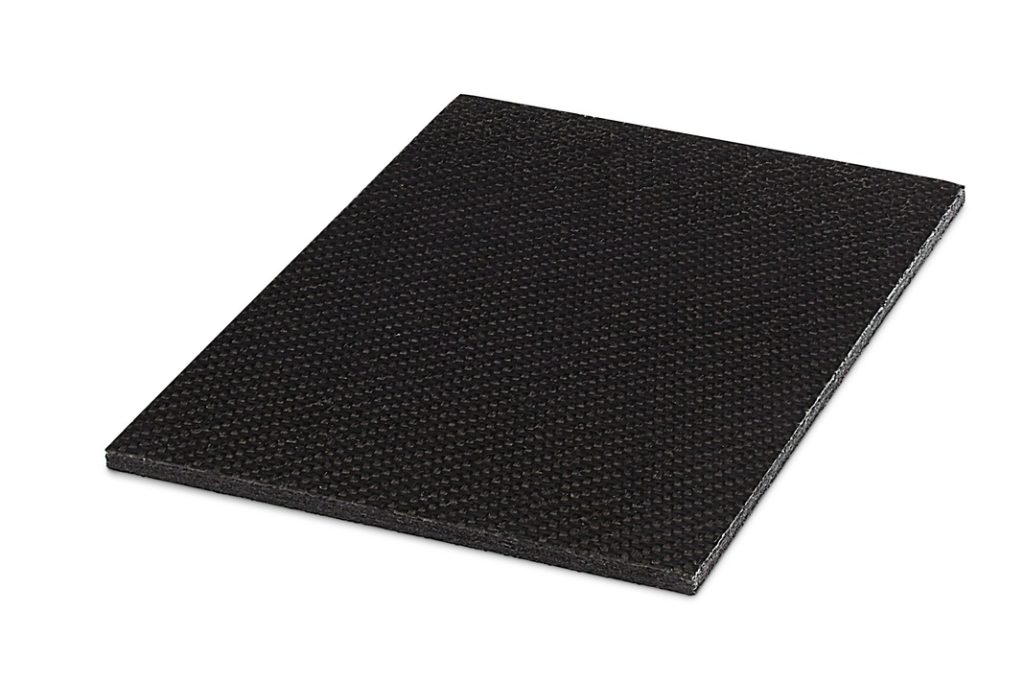
KyronTEX : The next generation of sustainable, high-performance composites
Reimagining composite materials, KyronTEX offers a dry-processed, recyclable alternative that fuses sustainability with strength
Industries are striving to lighten their environmental footprint without sacrificing performance. KyronTEX , developed by Mitsubishi Chemical Advanced Materials, is a composite material platform encompassing nonwovens and novel proprietary organofleeces that promises the best of all worlds: lightweight, strength, scalable manufacturing, and genuine sustainability.
Beside the non-woven technology, at the core of KyronTEX ’s unique design is an innovative “dry processing” technology for continuous fiber reinforcement. Unlike traditional thermoplastic prepregs that require polymer melting to impregnate fibres, KyronTEX manufactures its semi-finished composite sheets without melting the polymer at all. Instead, thermoplastic polymer in fibre form is blended with structural fibres such as carbon or glass in a dry state.
Mitsubishi Chemical Group employs a novel proprietary dry impregnation “organofleece” process: polymer fibres and continuous reinforcement fibres are mixed and mechanically entangled, often by needling, forming a fleece-like mat where each reinforcement strand is thoroughly intermingled with resin fibres. Crucially, no heat is used during this blending stage, so there is no melting or resin curing to make the sheet stiff. The result is a pliable “prepreg” fabric that remains as drapable as a textile at room temperature.
This uniquely supple prepreg is a game-changer for manufacturing, as it can be cut, layered, or even preshaped easily by hand or automated equipment. When it’s time to form the final product, KyronTEX organofleece and non-wovens are heated, either alone or in combination typically in a compression molding press or autoclave, to melt the thermoplastic matrix and consolidate the composite. Because the resin and fibres are already uniformly distributed in the dry state, the material melts and flows just enough to fully impregnate the fibres without needing traditional resin infusion or long cure cycles. The whole forming
process can take mere minutes instead of hours, yielding a finished component in a single heating cycle.
Designing for performance: Drapability and strength
KyronTEX ’s organofleece and non-wovens drapability is one of its standout qualities. Anyone who has wrestled with stiff prepreg tape or unforgiving thermoset fabrics will appreciate what a breakthrough this is. The KyronTEX fleece can be folded, draped over tight radii, and shaped into deep-drawn forms without the fibres buckling or the material cracking. During compression molding, the fibre movement is predictable and gentle, avoiding the usual wrinkles or resin-rich areas, so engineers can trust that the final part will meet design expectations. This drapability not only simplifies molding of intricate parts but also reduces the need for many separate pieces or joints, because shapes that might traditionally require assembly of several components can now be formed as one piece, cutting down assembly steps and potential weak points.
A key advantage of KyronTEX™ Non-Wovens lies in their unique expansion behavior. During the needling process with chopped reinforcement fibers, these materials develop a degree of Z-direction fiber orientation. This configuration creates an internal spring-like force due to the natural resilience of the reinforcement fibers, leading to a controlled expansion or “lofting” effect. This expansion enables the formation of parts with tailored air content and variable thickness, a property already leveraged in applications using MCG’s SymaLITE PP-GF composites. However, KyronTEX™ with PP-rCF offers enhanced expansion capability thanks to the higher E-modulus of carbon fibers, which results in lower achievable material densities.
In addition to improved expansion characteristics, KyronTEX™ PP-rCF delivers superior mechanical performance. Compared to PP-GF composites, it can either match mechanical strength at significantly reduced densities or outperform them at the same weight. This translates into notable weight-saving potential —up to 40–60% in stiffness and approximately 30–40% in strength—making KyronTEX™ an ideal choice for
lightweight, high-performance applications.
For industries such as automotive and aerospace where every kilogram matters, this strength-to-weight boost directly translates to better fuel efficiency, longer battery range, or higher payloads.
KyronTEX can also be configured as a “sandwich” structure to further optimise performance. Because the process can create both fully dense layers and low-density porous layers, one can combine, for example, a
rigid skin out of KyronTEX Organofleeces and an expanded lightweight core with KyronTEX Non-Woven in one material system. Mitsubishi has demonstrated monomaterial sandwich panels where the face sheets are fully consolidated KyronTEX (for surface strength) and the core is an expanded low-density KyronTEX fleece providing stiffness and insulation. Since all layers share the same thermoplastic matrix, they fuse together in molding and the entire sandwich is still a single polymer/fibre system, avoiding the need for glues or mixed materials recycling and reducing weight even further.
Sustainability woven in
Perhaps KyronTEX ’s greatest appeal is how well it addresses the sustainability imperatives facing composite industries. Traditionally, composites have had a recycling problem, with thermoset components ending up in landfills and often combining many materials that are hard to separate. KyronTEX was designed from the start to be entirely recyclable and to use recycled inputs, tackling both end-of-life and supply chain impacts. First, the matrix being thermoplastic means that at end-of-life, a KyronTEX part can be re-melted and reformed or shredded and reused as reinforcement in new composites with no irreversible chemical cures to deal with. Moreover, because KyronTEX parts can be made as single-material structures, recycling is straightforward, as you’re not trying to separate different resin or fibre types in the recycling stream.
Carbon fiber-based KyronTEX is offered either with virgin or recycled carbon fibre, and Mitsubishi Chemical has invested in vertically integrated recycling facilities that reclaim carbon fibre from sources such as
aerospace scrap. Using recycled fibre not only reduces raw material demand, it also massively cuts the embodied energy and carbon emissions of the product. Producing carbon fibre from scratch is energyintensive, so reusing fibre can reduce the carbon footprint by up to 90% in some cases.
Additionally, by omitting the repeated melting and cooling steps typical in making prepregs, KyronTEX avoids expending energy until the final part moulding. All these factors contribute to a material platform that is inherently more sustainable than legacy composites.
Applications taking flight (and hitting the road)
In aerospace, where regulatory hurdles are highest, KyronTEX has made impressive inroads. The material recently secured certification for use in an aircraft seating application, for components in airplane passenger seat system of a well-known Airline, marking its first approval in a commercial aviation context. While the TM details remain confidential under NDA, this certification implies KyronTEX met the stringent mechanical and flame-smoke-toxicity requirements for interior aircraft parts. Beyond seating, major aerospace OEMs are eyeing KyronTEX for other interior components. Boeing, for instance, has explored KyronTEX for its cabin sidewall panels as a potential replacement for traditional thermoset sandwich panels. By switching to KyronTEX ’s recyclable carbon fibre composite, Boeing anticipates significant emissions reduction across the panel’s lifecycle, from manufacturing through to end-of-life recycling.
The automotive industry is using MCG’s SymaLITE PP-GF thermoplastic glass fibre composites for interior trim and underbody shields. If weight saving or higher properties are required, KyronTEX PP-rCF can directly slot into those production lines using the existing equipment, but with the performance uplift or weight saving potential of carbon fibre and without a cost-prohibitive process.
Mitsubishi has indicated that electric vehicle (EV) battery cases and other high-volume structural parts are prime targets for KyronTEX , given the material’s ability to drastically reduce weight while being made in large sheets suitable for stamping. In performance and luxury vehicles, carbon fibre reinforced plastics offer weight reduction but are usually expensive and laborious to make; KyronTEX could change that dynamic by providing a cost-effective, recyclable alternative that comes off a roll.
In the sports and leisure industry, the material is already being used. One case study saw KyronTEX employed to improve motorcycle helmet manufacturing, enabling a more cost-effective and higher-quality
helmet by replacing a multi-step process with a simplified KyronTEX -based layup. Sporting goods such as helmets, protective gear, bicycles or skis benefit from the same attributes: lighter weight, high impact
strength, and quick mould cycling, plus the marketing bonus of recycled content. Even within industrial equipment, there is interest, with one early trial using KyronTEX to stamp-form a complex aerospace rib
structure as a demonstrator, proving the material could handle demanding load-bearing geometries. The rib, produced with partner ATC Manufacturing and shown at industry events, is now being evaluated for potential commercial adoption.
What is common across these examples is that KyronTEX enables designs that were previously difficult or uneconomical in composites. Large, thin-walled interior panels, intricate structural ribs, and one-piece
moulded shells would typically be too costly with thermosets or too hard to form with standard thermoplastic sheets. By solving those pain points, KyronTEX is unlocking new uses and bridging the gap between lab innovation and high-volume production.